
Field Notes from the West Bank, Luxor
I don't eat much bread. Especially white bread. It's not something I would ordinarily buy for myself.
Yet this morning, I returned home with two little breads, given to me by an 86-year-old Egyptian woman whom had never met me before.
She was absolutely determined that I take them.
And I've been thinking about those breads all morning.
The Things We Have
I grew up in a family with limited financial resources. I wouldn't necessarily describe myself as economically deprived today, but I certainly know what that feels like.
I've also experienced the opposite: access to extraordinary opportunities, international travel, world-class education, and the luxury of having choices.
Much of that required considerable effort. When I attended one of the world's leading belly dance schools, it was a big deal. I had arts funding, and I worked hard to make that experience possible.
So my relationship with resources has never been particularly straightforward.
Since moving to Luxor, I've found myself thinking about the things I have, the things I need, the things I waste, and how much of my life has been organized around having options.
In Cairo, options are everywhere.
If the produce at one market looks tired, there's another market. If I don't feel like cooking, food can arrive at my door. If I'm running between appointments, there's always someone selling something delicious on the street.
I could get practically anything delivered. Not in Luxor, I even brought real soy sauce and espresso with me from Cairo when I came.
Luxor is different.
I'm living on the West Bank, where the pace of life is considerably slower, the commercial options are fewer, and many ordinary tasks require a little more effort.
The other evening, I walked home carrying thirty eggs on a tray. A ten-minute walk, carefully balancing my groceries.
I'm also learning to cook on a gas stove, having used electric stoves for most of my life.
Even rice requires a little adjustment.
Recently, I bought some beautiful lettuce, only to discover that the attractive outer leaves had been concealing older, denser leaves inside.
Ordinarily, I might have thrown them away.
Instead, I stir-fried them with chili oil.
And they were perfectly good. And tasty infact, with a splash of imported soya sauce.
I'm beginning to recognize how much food I've discarded simply because I had the option of replacing it. Not necessarily because it was unusable, but because something better was available.
A Walk in the Morning
This morning, I went looking for fresh produce.
I've learned that shopping late in the evening isn't particularly advantageous here. By then, the nicest fruits and vegetables have often been picked over for the day.
So I walked a little farther up the main road to a couple of fruit shops.
The produce looked tired.
I asked the shopkeeper:
الفاكهة الجديدة جاية إمتى؟
El-fakha el-gedida gaya emta?
When is the new fruit arriving?
ربع ساعة.
Rob3 sa3a.
Fifteen minutes.
Fair enough.
I decided to keep walking.
I've been trying to spend more time outside, particularly among the trees. Every time I return to Luxor, I experience a quality of quiet that I cannot seem to find in Cairo.
Even when I'm alone in a completely empty apartment in Cairo, the atmosphere is different.
Here, there is a particular stillness.
And each time I've come back, something in me seems to release.
I've been moving through a particularly difficult chapter of my life, and despite having a home here, I haven't really settled into the rhythm of living in it.
My stays have been brief. First two days, then five, then a couple of weeks. Between those visits, I've continued traveling, working, and staying with other people.
So each time I return to Luxor, there's an adjustment.
The first few days are particularly intense. When the movement stops, when there are no appointments to keep or people to engage with, I'm suddenly left with the quiet.
And in that quiet, I still grieve.
I think I've been so accustomed to moving through life that I'm only beginning to understand what happens when I finally sit still.
It's not necessarily unpleasant. But it isn't always peaceful, either.
Sometimes the stillness simply gives me enough space to feel what I've been carrying.
And perhaps that's why I found myself walking toward the agricultural land that morning.
I wasn't particularly interested in meeting anyone.
I already know plenty of people. Most of them simply aren't nearby. I have long-standing friendships, meaningful relationships, and enough work and writing to occupy much of my time.
I'm quite content in my own company.
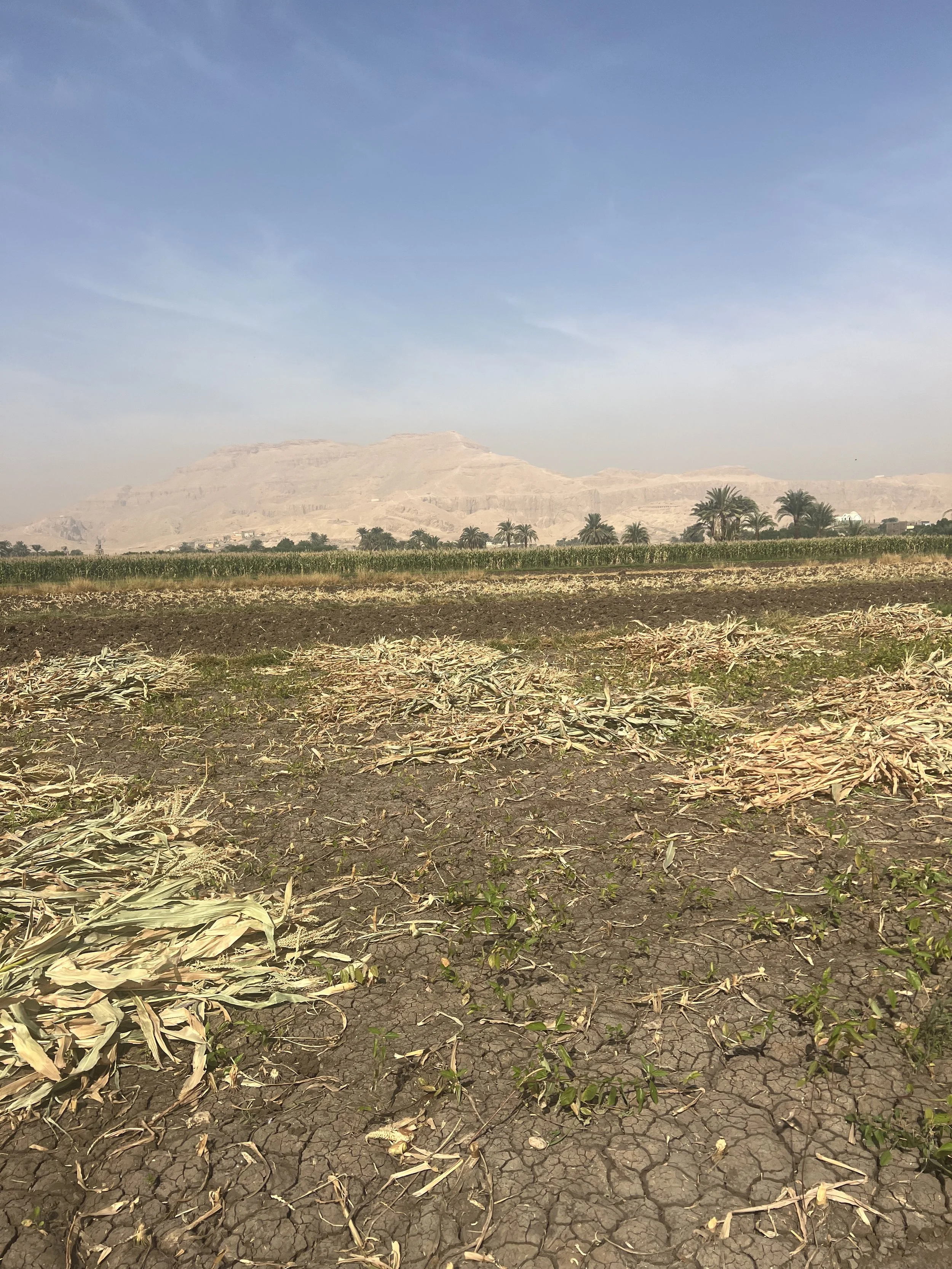
Theban Mountains from across the corn field
What I wanted was to sit somewhere among the trees, feel the ground beneath me, and enjoy the morning.
Eventually, I found a place and sat down.
A man approached.
صباح الخير.
Saba7 el-kheir.
Good morning.
صباح النور.
Saba7 el-nour.
Good morning to you.
I explained, in my developing Egyptian Arabic, that I thought the garden was beautiful and wanted to sit beneath a tree.
الجنينة حلوة، عايزة أقعد هنا تحت الشجرة.
El-geneina 7elwa, 3ayza a2od hena ta7t el-shagara.
The garden is beautiful. I want to sit here beneath the tree.
I wanted to rest.
عايزة أريح نفسي.
3ayza arayya7 nafsi.
I want to relax.
He invited me farther into the garden.
His name was Hamada.
A Little More Than I Went Looking For
Hamada showed me his land, the canal, and his مشتل (meshtal), or plant nursery.
We talked about where I came from.
I explained that although I'd lived in Cairo for five years, I was originally from a small town in Canada, smaller than Luxor.
This sometimes surprises people. I suspect there's an assumption that foreigners come from enormous, sophisticated cities.
I try to explain that I grew up somewhere quite small, and that being among trees and gardens isn't some exotic recreational activity for me.
It's familiar.
My Arabic isn't perfect, but it's becoming good enough to have real conversations.
We laughed over my pronunciation of يوسف أفندي (Youssef Effendi), the Egyptian name for a mandarin orange, which I apparently managed to say more like someone's actual name.
But we understood each other.
We sat together and had tea.
I explained that I would love to visit his garden occasionally, simply to sit among the trees, and that I would happily bring something in exchange.
I wasn't looking for an organized activity, a guide, or entertainment.
I just wanted to sit outside.
Eventually, Hamada offered to take me back toward the fruit shops.
Before leaving, he showed me his home.
He also happened to have a papyrus shop, something he hadn't even mentioned during our time together.
I found that rather funny, considering how recently I'd been wondering who even buys papyrus anymore.
But he hadn't tried to sell me anything.
He seemed to understand that I'd come for the garden.
The Grandmother
Hamada's home had a lower level, where his grandmother was sitting.
She was approximately 86 years old.
He introduced me, explaining that I was Nawal and that I lived here now.
I tried to greet her.
السلام عليكم يا حاجة.
El-salaam 3aleiki ya 7agga.
Peace be upon you, auntie.
Nothing.
I tried again, louder.
Still nothing.
Hamada started laughing.
صوت عالي! لازم صوت عالي!
Sout 3ali! Lazem sout 3ali!
Louder! You have to speak loudly!
Apparently, I had underestimated just how loudly.
He eventually touched her shoulder to get her attention.
I explained:
عايزة أقولك السلام عليكم بس.
3ayza a2ollik el-salaam 3aleiki bas.
I just wanted to say hello.
Once she understood what was happening, she immediately became concerned with something else.
Hospitality.
She wanted to know if I'd like tea.
I'd only just finished drinking tea with Hamada, so I politely declined.
I had groceries to buy and was preparing to leave.
But she wasn't finished with me.
استني.
Estanni.
Wait.
She disappeared into her room.
There, tucked away in a cupboard, she had a little bag of dried breads and buns.
She rummaged through it, carefully selecting two.
And she insisted that I take them.
Not one. Two.
She placed them directly into my hands, making sure I understood that I should have them with tea.
There was something wonderfully endearing about her determination. This woman could barely hear my greeting, but she wasn't about to let me leave her home without offering me something.
I thanked her and promised to visit again.
I carried the little breads until I could tuck them safely into the small pocket of my reusable cotton grocery bag.
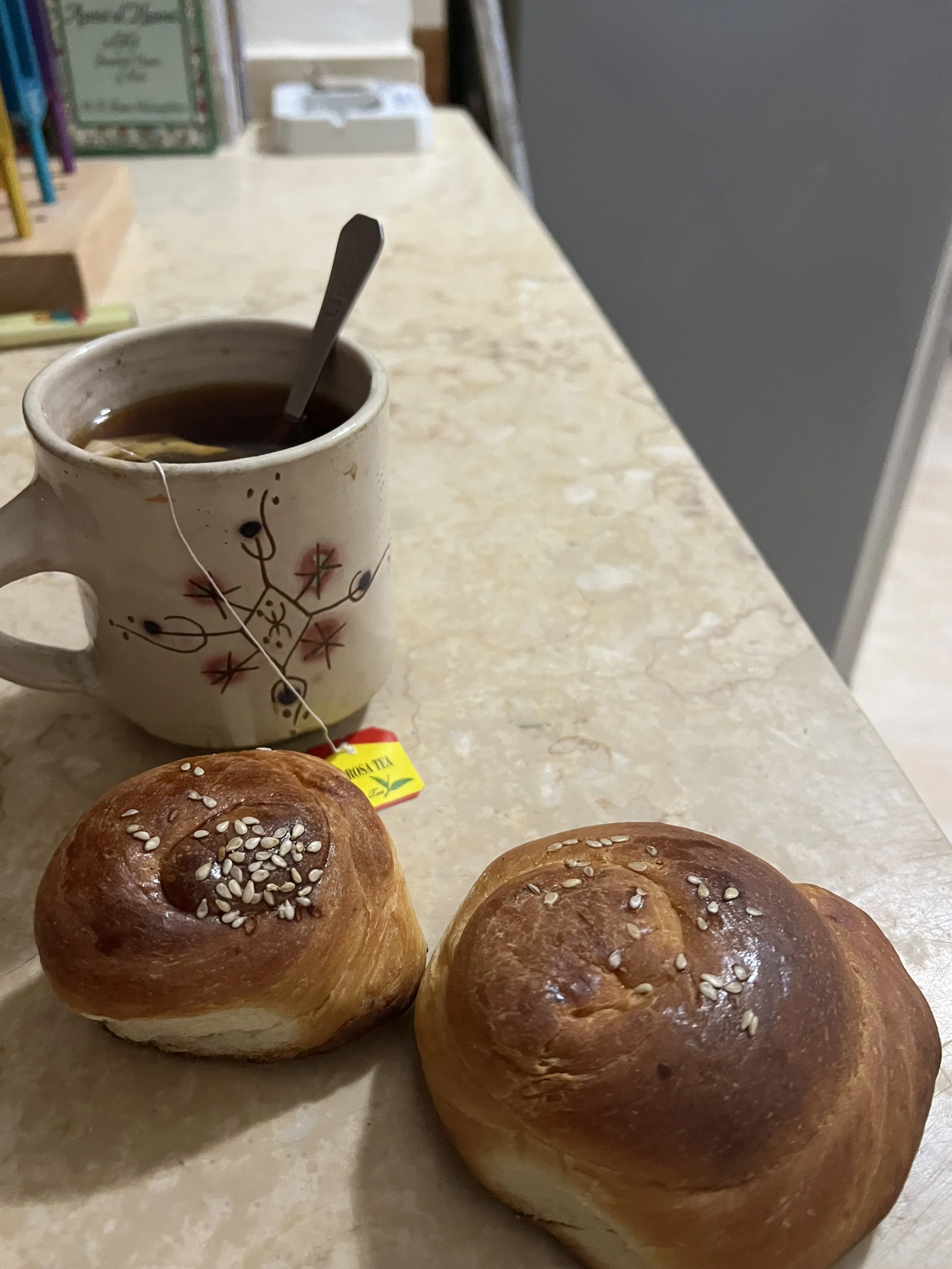
I would NEVERRR go get these myself…
They made it home perfectly intact.
What We Have to Give
I keep thinking about the fact that she had those breads tucked away in her own cupboard.
I don't know why she kept them there, or what else she had available.
I don't want to invent a story about her circumstances.
But I know what I saw.
An elderly woman, minding her own business in her home, who couldn't hear a word I was saying, nevertheless understood that a visitor had arrived.
And she wanted to give that visitor something.
It didn't matter that we were strangers.
She had something to offer.
And so she offered it.
The experience reminded me of another encounter here in Luxor, when an elderly man gave me little tufts of cotton from beneath his tree.
Such small things.
Things I would never have thought to purchase, and things whose monetary value is almost beside the point.
Yet I remember them.
I've also encountered the more transactional side of life in Luxor. When you look like a foreigner in a place shaped by tourism, not every interaction is without expectation.
I'm conscious of that, and I try to navigate my relationships here carefully.
Living in a village requires a different kind of social awareness than living in Cairo. People know each other, reputations travel, and I want to maintain good relationships within the community.
I don't want to romanticize village life or pretend that generosity is exclusive to people who have fewer material possessions.
But I am observing differences in how people relate to what they have.
And perhaps, more importantly, how I relate to what I have.
Learning a Different Pace
After leaving Hamada, I finally bought my fruit.
I also needed drinking water.
I don't drink the tap water here, and I was looking specifically for Baraka.
Eventually, I found a shop selling it.
I asked the woman if they delivered.
No.
So I went outside, found a tuk-tuk, and arranged for the driver to bring two boxes of water to my apartment.
Another ordinary task that would have taken almost no thought in Cairo.
Here, I have to organize things differently.
I can only carry so much. I can only eat so much. I can only store so much.
And I don't particularly want to spend my days struggling with groceries.
So I'm learning to think ahead.
How much food do I actually need?
How often do I need to cook?
What can I make with what I already have?
What happens when I stop treating convenience as the default?
These aren't particularly revolutionary questions.
But they're becoming part of my daily life.
I've also been visiting homes here that, through Western eyes, might appear unfinished.
My own apartment is comparatively comfortable and furnished to a standard that would appeal to many foreigners.
And even though I don't have access to all my belongings at the moment, I still have an extraordinary amount of stuff.
My vanity alone is covered in skin-care products, serums, and moisturizers.
More products than I've seen in the bedrooms of many women I've visited here.
Of course, we lead different lives. We have different priorities, occupations, habits, and expectations.
I'm not particularly interested in judging one lifestyle against another.
I'm more interested in noticing my own.
What do I need?
What do I enjoy?
What have I accumulated simply because I could?
And what am I reluctant to live without?
The Things We Throw Away
Growing up in Canada, I was accustomed to fairly stringent rules about household waste. Garbage, recycling, organics, bottles, cans. Everything had its place, and you were expected to know the difference.
Anyone who's spent time in Egypt knows that garbage is a problem. I've watched people casually throw packaging out of car windows, seemingly without a second thought.
Yet Cairo has an extraordinary recycling story of its own, through the Zabbaleen, the communities that collect, sort, and recover enormous amounts of the city's waste.
That deserves an essay of its own.
Here on the West Bank, I don't even carry my garbage to the dumpster anymore, as I did in Cairo. I leave it at the bottom of the stairs for collection.
But I find myself sorting it more carefully than ever.
Bottles and cans together. Other recyclables separated. Organic waste in its own bag. If I accidentally throw a piece of plastic into the organics, I'll actually take it out and rinse it.
I feel genuinely uncomfortable just leaving it there.
I don't know exactly what happens to everything after it leaves my building, but living this close to the farmland has made me more conscious of what I'm putting back into the world.
That morning, Hamada showed me the irrigation canal running through his land. The surrounding earth looked remarkably dry, and the water channel was small. It was a different agricultural landscape from what I'd seen in Ismailia.
I've also been noticing how low the Nile appears.
Water, food, land, waste.
Things that modern convenience allows us to forget about until we're confronted with them.
And I'm certainly not exempt.
I travel internationally. I appreciate air conditioning. I have a vanity full of products promising to preserve my skin, some of them containing ingredients I couldn't have imagined putting on my face twenty years ago.
Salmon PDRN, anyone?
We wake up, switch on the air conditioner, order another product, use increasingly powerful technology, including AI, and consume resources just to maintain what we've come to consider an ordinary standard of living.
At what point did all of this become ordinary?
It's easy to look at the environmental state of the world and declare that everything is fucked. And then, having accepted that conclusion, justify whatever little comforts help us get through another day.
But what about tomorrow?
I'm not planning to renounce modern life or throw away my moisturizers. Nor do I imagine that meticulously sorting my garbage is going to solve an environmental crisis.
But I am questioning my relationship with consumption, and whether having the means to acquire something should automatically translate into acquiring it.
Perhaps living here is encouraging me to become more conscious of the space I occupy and the resources I use.
Not necessarily to have less for the sake of having less.
But to consider what enough actually looks like.
Between the Temples
I'm living in a remarkable place.
From my rooftop, I can look across the Nile toward Luxor Temple. Behind me, the landscape rises toward the Theban mountains and the Valley of the Kings.
I'm surrounded by traces of a civilization that has fascinated me for most of my life.
But what I'm discovering here isn't confined to the archaeological sites.
It's happening in the markets, on the roads, in the gardens, and inside people's homes.
In the ordinary rhythms of a place that continues to live around its ancient monuments.
I came to Luxor with considerable experience traveling the world, and with my own ideas about how I like to live.
I haven't suddenly stopped enjoying beautiful things, good food, or the freedom to choose.
I'm still particular about my lettuce.
But there is something valuable about having fewer immediate options.
It requires me to pay attention.
To the timing of the market.
To what I can carry.
To what I can use instead of discard.
To the resources required to make my ordinary life possible.
And to the people I encounter while taking the longer way home.
I went out this morning looking for fresh fruit.
Instead, I found myself sitting among the trees, drinking tea with a stranger, practicing my Arabic, and visiting his elderly grandmother.
I returned with my groceries and two little breads that I hadn't expected to receive.
They made it home safely in the little pocket of my cotton grocery bag.
And this afternoon, I sat down with my tea and ate one.
Just as she'd told me to.
