
On the lives we leave behind, the things we take with us, and what it means to feel at home.
Something a lot of you might not know about me is that I left home when I was sixteen years old.
It was the summer after Grade 11, and I had absolutely no idea where I was going.
I left with a bag.
That was it. A fucking bag.
And I didn't leave because I was some adventurous teenager eager to experience the world. I left because I was genuinely afraid for my life.
I'm not exaggerating.
My relationship with my father had become a source of tremendous fear. He would accuse me of things that simply weren't true. I remember him claiming that he had seen me visiting drug houses during my school lunch breaks.
The accusation was completely fabricated. I hadn't even left school during lunch.
But how do you defend yourself against someone who insists they've witnessed something that never happened?
And how do you reason with someone you're terrified of?
At sixteen, I didn't have the language or perspective to understand everything that was happening around me. I only knew that I was frightened, that I didn't feel safe, and that remaining in those circumstances felt more dangerous than leaving without knowing where I would go.
So I left.
There was no carefully considered plan, no financial security, and certainly no guarantee that things would be better elsewhere.
But somehow, even then, I trusted myself more than the circumstances I was living in.
I went on to finish high school and begin university entirely on my own, before eventually realising that conventional academia wasn't quite my path. I gravitated toward certificates, practical training, hands-on experience, and what I've come to affectionately call the school of life.
And I continued building a life.
What strikes me now, more than twenty-five years later, is that I find myself confronting something disturbingly familiar.
Once again, there are accusations I maintain are untrue. Once again, family relationships have become a source of fear and uncertainty. And once again, I find myself weighing what I stand to lose against what it might cost me to remain engaged in the conflict.
The circumstances are different, of course. I'm no longer a frightened sixteen-year-old with a bag and nowhere particular to go.
But I recognise something of that old feeling.
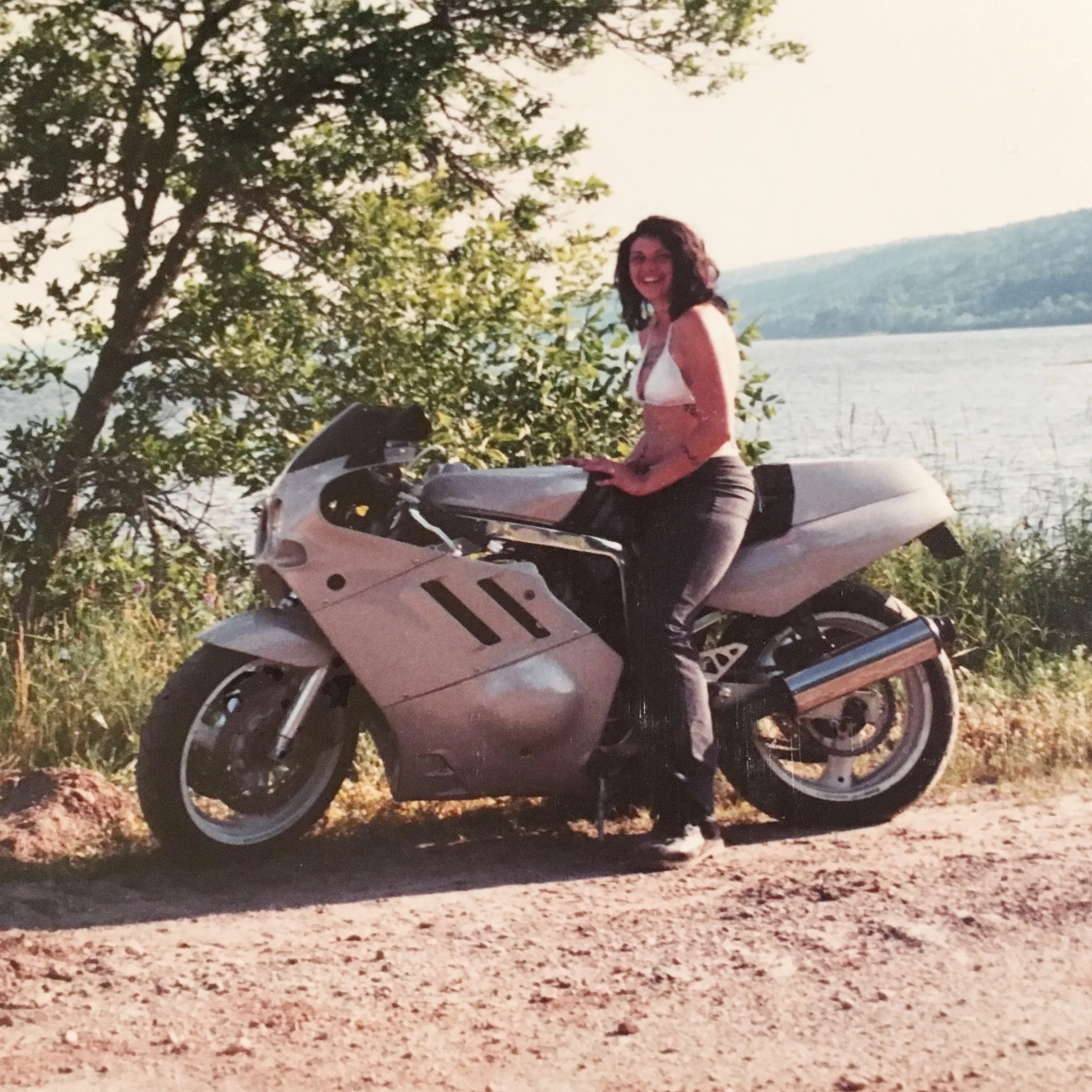
19 year old Nawal with her Suzuki GSXR750 2004 Victoria Beach, NB, Canada
And perhaps that's one of the things I've been carrying all along.
By Twenty, I was married.
And for nearly fifteen years, I lived an entirely different existence. I became a mother, built a household, developed my business, travelled, taught, danced, and accumulated all the wonderful and ridiculous things that come with maintaining a life.
I had an office and an art room. I spent years making costumes, collecting fabrics, beads, trims, art supplies, tools, and materials for projects that existed in various stages of completion.
Anyone who has ever worked with their hands knows how these things accumulate.
A particular fabric might be useful one day. A certain trim might be impossible to find again. And of course, you absolutely must keep that box of mysterious objects because you never know when you'll need it.
My household wasn't just a collection of possessions. It was the physical infrastructure of my creative life.
When my marriage ended, that chapter eventually had to be dismantled.
In late summer 2022, I returned to Canada to clear out the storage I'd left behind after leaving in Sping 2021.
I recommend that absolutely nobody ever do this.
If you have a storage unit in another country containing the remains of a previous existence, and it's been more than a year, my advice is simple: don't go back.
Unless there's something desperately important in there, leave it alone. If you must clear the storage, simply empty it, do not go through it.
Every box becomes a small archaeological excavation.
Things that were once part of your ordinary Tuesday afternoon suddenly demand that you decide whether they deserve to accompany you into the next chapter.
Keep it? Sell it? Give it away? Throw it out?
In my case, almost everything had to go. I was returning to Egypt, and there was no practical way to bring an entire household and art studio across the ocean.
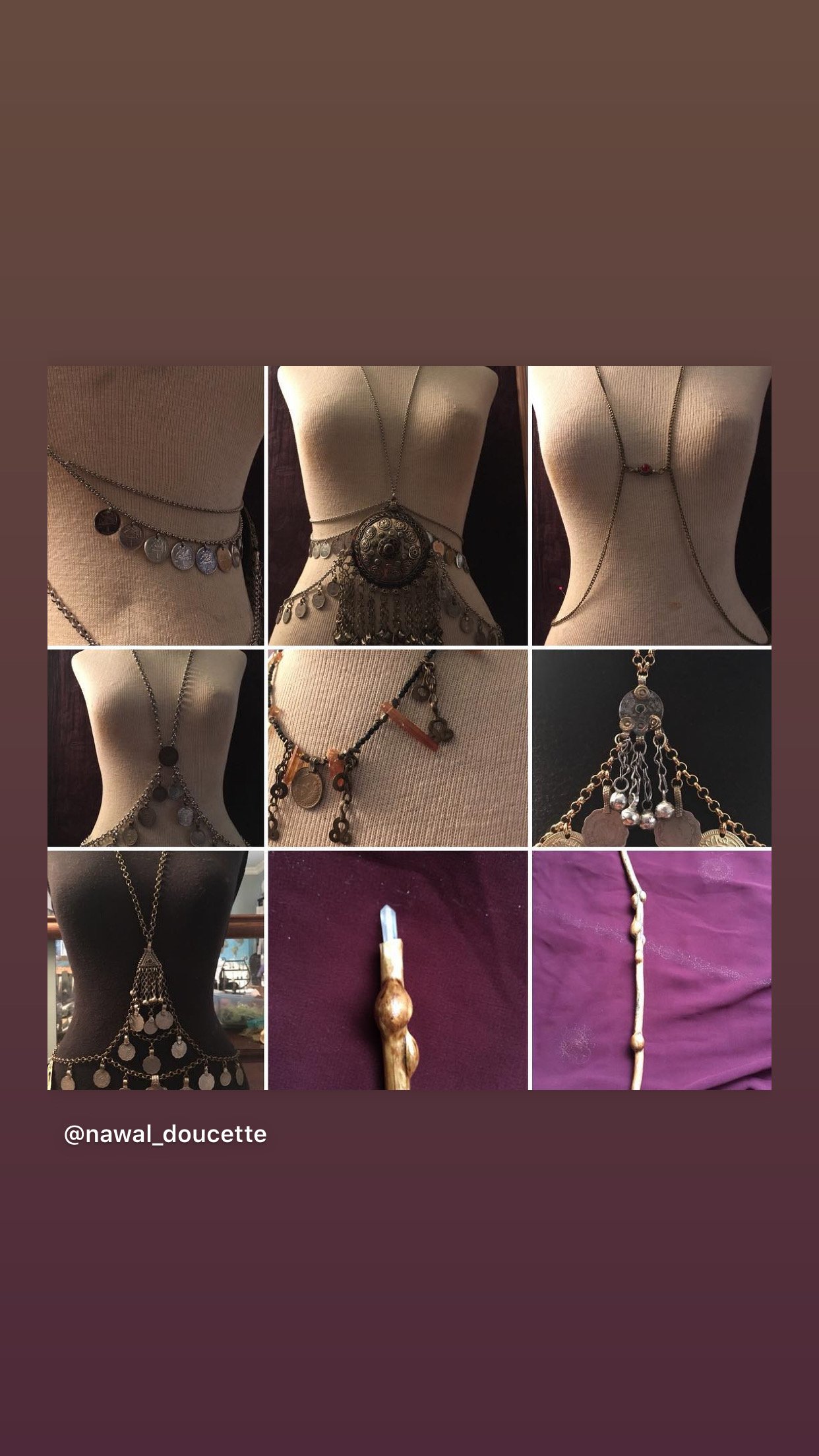
Some of my creations I made in my studio.
I sold ALL my costume-making supplies and art materials in bulk, often to people within my own network. Other things I simply gave away.
Years of carefully gathered materials, gone in a matter of weeks.
It was a deep feeling of loss, even though I was genuinely excited about the life I was moving toward.
And eventually, I returned to Egypt with two suitcases.
There is something liberating about travelling light, particularly when you know you've chosen your own direction.
But there's also something rather extraordinary about looking at two suitcases and realising that they contain practically everything you've decided to bring forward from your previous life.
What do we actually need?
And what makes something worth carrying?
Over the next several years, I rebuilt a life in Egypt.
I worked, established a home, collected furniture, appliances, books, clothes, and all the strange little conveniences that slowly transform an empty space into somewhere familiar.
I even furnished multiple apartments within our family villa.
And now, several years later, I find myself in a rather absurd situation.
A painful family dispute has left me unable to access the house where I lived, along with many of the things I've accumulated since coming to Egypt.
There are legal complications, financial disagreements, and an assortment of family problems that I couldn't possibly explain without turning this essay into an entirely different kind of publication.
My mother is gravely ill, my sister has died, and the family relationships that might ordinarily offer some stability during such circumstances have become another source of distress.
It's a big shit show, to put it delicately.
And here's the particularly ridiculous part.
I can't even get my winter clothes.
After all those years of travelling, collecting things, giving things away, starting fresh, and convincing myself that I'm not particularly attached to material possessions, I now find myself contemplating whether it's worth pursuing legal action to retrieve a wardrobe.
Among other things, of course.
There's furniture, equipment, artwork, household items, and the accumulated evidence of several years of living.
But somehow it's the winter clothes that make the whole situation feel especially absurd.
Perhaps because winter is coming, and philosophy doesn't do a particularly good job of keeping you warm.
I've been thinking about this alongside another observation I've made over the years.
There are people who stay, and people who travel.
I've written before about the beautiful simplicity of lives built around familiar places, families, and routines. People who remain in one location long enough to know everyone, accumulate histories with their neighbours, and establish the kind of everyday continuity that travellers often move through rather than create.
I'm fortunate enough to be welcomed into those lives.
In Cairo, I have friends whose homes are so familiar that I've practically been assigned my own room.
I'm invited into family gatherings, ordinary evenings, dinners, coffee, and all the small happenings that make up domestic life.
Sometimes they tell me not to leave.
And I love them for it.
I've always believed that home is something we carry within ourselves.
I've felt at home in cities, villages, deserts, and other people's kitchens. I've been welcomed into families and communities thousands of kilometres from where I was born.
I don't necessarily need to own the walls around me to feel that I belong.
But there's a difference between feeling at home and having a home.
And sometimes that difference comes down to something as ridiculous as a fingernail brush.
Or a particular pair of scissors.
You know the ones.
The little objects you've collected over years that make ordinary life easier. The favourite coffee cup, the useful drawer, the scissors that actually cut properly, the particular brush you've never found an adequate replacement for.
A home gradually accumulates these things.
Not because they're particularly valuable, but because they're familiar.
There is an extraordinary convenience in knowing exactly where everything is.
And a certain exhaustion in having to recreate that familiarity.
When I stay with friends, I have the enormous privilege of entering a world they've already established.
Their kitchens are organised. Their routines exist. Their lives have an infrastructure built over years of remaining in one place.
I bring my stories, my company, perhaps a few interesting conversations, and they generously make room for me.
But who maintains that kind of world for the traveller?
And what happens when the traveller finally wants one of her own?
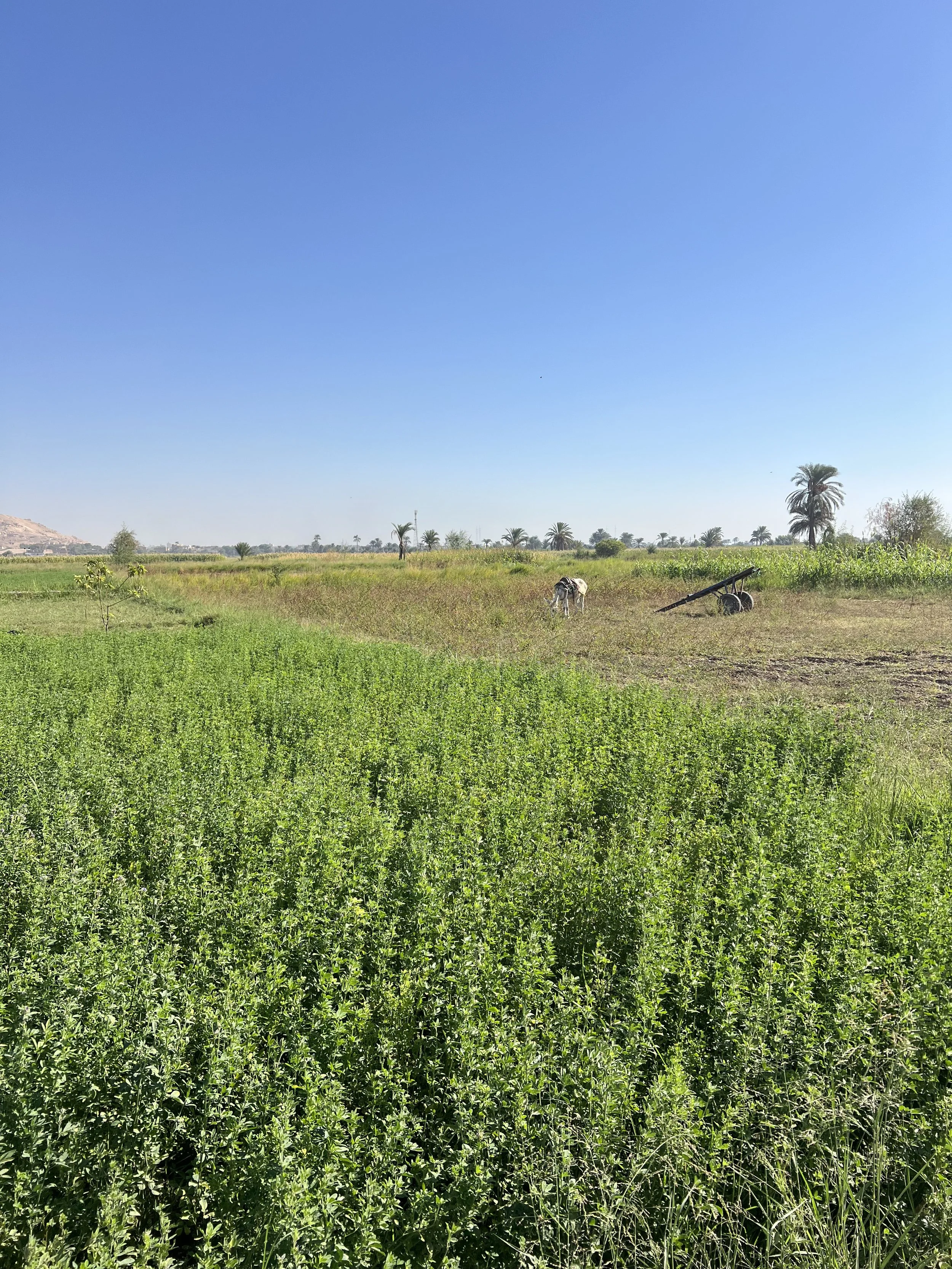
Luxor, Egypt
Recently, I've moved into a place in upper egypt
I've been imagining what it might feel like to have my own routines again. To practise in the morning, write, work, prepare meals, and enjoy the ordinary pleasure of having my things where I left them.
Although, in keeping with my usual habits, I've barely spent any time there.
I seem to be remarkably good at establishing homes and leaving them.
But this particular chapter has made me think about the relationship between our possessions and our sense of security.
At sixteen, I left with a bag because I believed I could create something better for myself.
When I left Canada, I gave away or sold nearly everything because I wanted to move forward into another life.
And now, facing the possibility of losing access to so much of what I've built in Egypt, I find myself wondering how much of that same willingness to let go still exists within me.
Part of me wants to pursue every legal avenue available, recover every last possession, and insist upon what belongs to me.
Another part of me wonders whether the energy required to do so would cost more than the things themselves.
Because legal disputes, family conflict, and endless confrontation have a way of making themselves known in the body.
Stress doesn't remain politely contained within the mind. It shows up in digestion, sleep, tension, exhaustion, and the general feeling that your nervous system has decided to abandon you.
And I find myself weighing the value of my belongings against the value of my peace.
Sometimes, in an attempt to make sense of it all, I imagine that the house simply burned down.
Everything gone.
No one to argue with, no one withholding anything, no legal complications. Just an unfortunate catastrophe, and the unavoidable task of moving forward.
Other times, I imagine the far more devastating reality of people who have lost their homes to war or displacement.
I wonder whether imagining something worse is my peculiar way of trying to make the present situation easier to accept.
Although the mind is a funny thing.
Sometimes the hypothetical catastrophes become so elaborate that I have to remind myself that I was only trying to feel better.
And then I wonder why I need to imagine something worse at all.
Isn't the situation I'm already experiencing difficult enough?
Perhaps one of the stranger habits I've developed over the years is the ability to detach from circumstances when they become unbearable.
To say, well, I suppose I'll find another way.
I've been doing that since I was sixteen. And young im sure if i dare to excavate that.
And while it's given me a tremendous amount of freedom, I sometimes wonder whether it's also become my default response to discomfort.
Am I moving forward because that's genuinely where I want to go?
Or have I simply become exceptionally good at leaving things behind?
One of the more curious things about this period is that my friends keep telling me how much better I look.
"You look so much better than last month!"
Apparently, last month I resembled some kind of grey phantom.
And compared with two months ago, I'm told the improvement is even more remarkable.
Which is lovely to hear, of course.
But it has left me wondering what exactly they're seeing.
Because when I look at the circumstances of my life, I can't honestly say that much has been resolved.
My mother remains gravely ill. The family disputes haven't disappeared. My possessions are still inaccessible, the legal matters remain open, and I'm only beginning to establish myself in my new home.
There hasn't been some tremendous breakthrough or grand resolution.
And yet, perhaps something has changed.
Perhaps I've become less consumed by circumstances I cannot immediately control.
Perhaps reconnecting with friends, continuing my work, travelling, writing, laughing, and allowing myself to enjoy life despite everything has had a greater effect than I realised.
Or perhaps I simply look better because I've been getting more sunshine and remembering to eat properly.
Entirely possible.
But it raises an interesting question.
Does progress always have to look like something has been accomplished?
Can we be doing better even when our circumstances haven't improved?
Can we feel more at home within ourselves while the physical structures of our lives remain uncertain?
And perhaps most importantly, can we continue to care about what we've built without allowing the possibility of losing it to consume us?
I don't believe that the answer is to become entirely unattached to the material world.
I like my things.
I like beautiful fabrics, books, artwork, good coffee, useful tools, and the comforting familiarity of an organised household.
I enjoy the process of creating a home, choosing objects, arranging spaces, and surrounding myself with things that support the way I live and work.
And I don't think there's anything particularly unenlightened about that.
But I also know that most of what I consider essential today would once have been entirely unfamiliar to me.
The sixteen-year-old who left home with a bag certainly wasn't worrying about which pair of scissors she preferred.
She was simply trying to find her way.
And somehow, despite everything, she did.
Perhaps that's the thing I've been carrying all along.
Not the belongings, not the houses, not even the accumulated evidence of the different lives I've lived.
But a certain trust in my ability to navigate circumstances, even when I have absolutely no idea what's going to happen next.
I don't know whether that trust comes from personality, necessity, or years of practice.
And I don't know whether my willingness to move forward has always served me well.
Perhaps there are times when I should have stayed longer, fought harder, or allowed myself to become more attached.
Perhaps there are times when leaving was exactly the right thing to do.
I'm still trying to understand the difference.
But I think what I'm looking for now is the ability to carry that trust in myself without always needing to put it to the test.
To enjoy the ordinary comforts of a home without imagining that I need to prove I can live without them.
To appreciate the lives I've built without measuring their value by how long they lasted.
And perhaps to recognise that the most important things we carry aren't necessarily the ones we can pack into a suitcase.
