
The Complexity of “Simple” People
Reflections from Siwa on civilization, survival, and the roads that appear when we start walking.
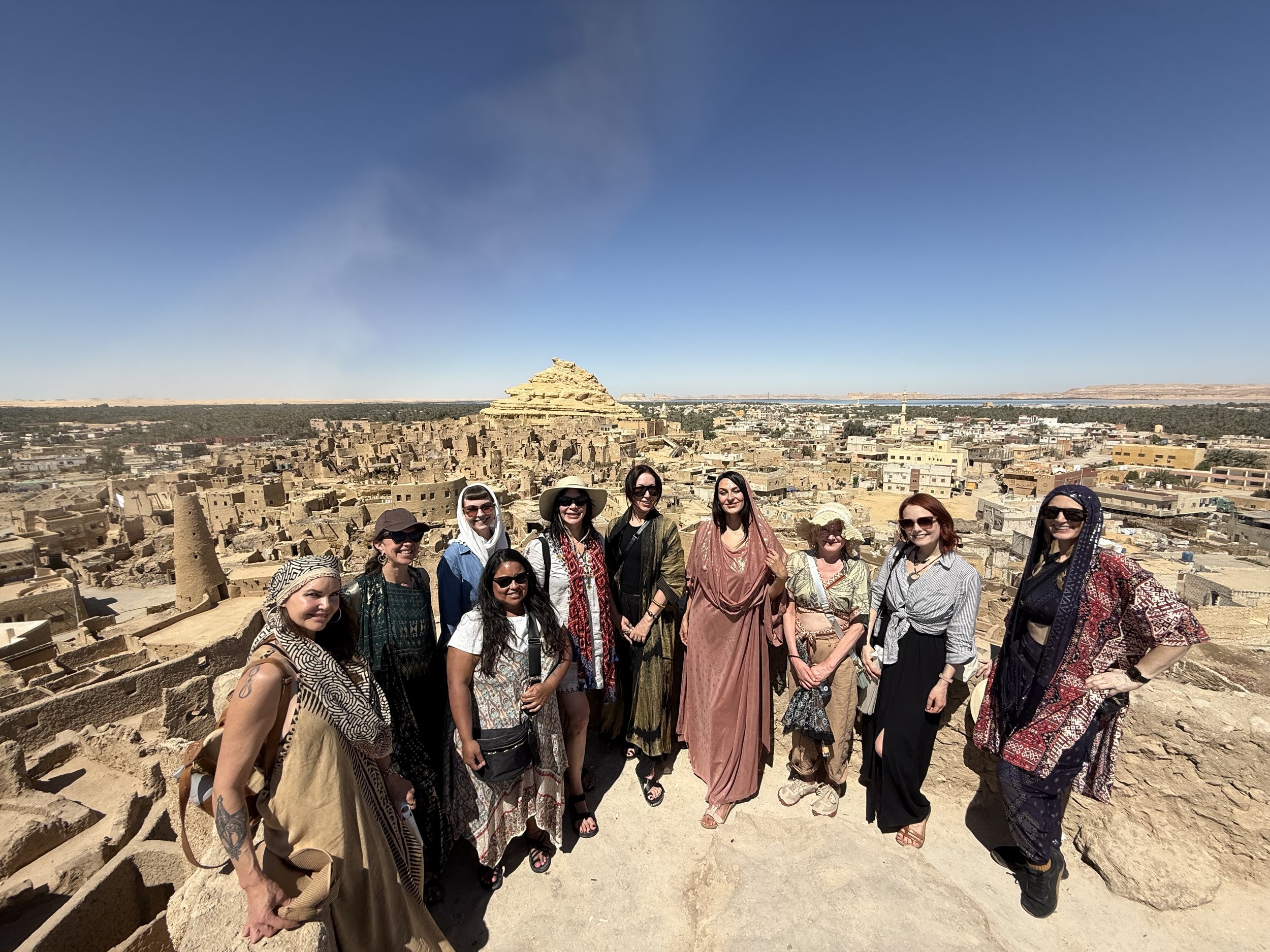
I’m back in Siwa for five days, teaching yoga. It’s my third visit here this year.
The first time I came was in January, when I was invited to teach yoga as part of a horse-riding tour. I immediately understood why this little oasis, tucked away in Egypt’s Western Desert, has such a hold on people.
I returned in April with guests from California who had seen my videos and insisted on adding Siwa to our journey. Now I’m here again.
It’s been quite a year.
Those of you who have been following along may have noticed that I more or less disappeared for a while. A lot has happened in my personal life, much of which I’m still processing, and I’m only now beginning to regain some colour in my face and a sense of myself.
After spending a long time being subjected to other people’s projections of who I was, what I was, and what I was supposedly responsible for, I needed distance to remember who I actually am.
Thankfully, I still have to work. And thankfully, work has continued to find me.
This time, it brought me back to Siwa.
Writing While Walking
I’ve been writing quite a lot these past few weeks.
Writing isn’t new to me. I’ve always written in personal notebooks and on blogs attached to old websites that have long since expired or disappeared into the internet graveyard. Over the years, people from my communities have told me how much they enjoy getting a glimpse inside my brain.
I’ve always wanted to make more time for it, but somehow writing kept getting pushed aside. And pushed aside. And pushed aside.
Years go by like that.
Now, as I shape a new life and figure out what I actually want my days to look like, writing has found its place again. It has become part of how I process what’s happening around me.
A little like journalling, except my ADHD brain tends to process things by talking them out loud, often right in the middle of experiencing them.
Some people might call that oversharing. Lol.
I’ve never been particularly bothered by sharing my mistakes, insecurities, or embarrassing moments. I can usually find the humour in them, even when I’m the punchline.
People sometimes see a woman with tattoos, an interesting outfit, and a life built around travel and unusual work, and assume she has everything figured out.
And Alhamdulillah, my life has been incredibly inspiring. To me, anyway.
But that doesn’t mean I don’t experience insecurities, make terrible decisions, or occasionally make a complete fool of myself.
I’ve had people tell me they couldn’t believe I was comfortable sharing some ridiculous or embarrassing story.
My response is usually: why wouldn’t I share it? It’s hilarious.
Even when the joke is on me.
Lately, writing has been helping me make sense of the last few months. As I process one experience, another step seems to open up in front of me.
You know that saying about starting to walk and the road appearing?
I’m somewhere in the middle of that right now.
And this week, the road has brought me back to Siwa.
The Man Who Had Everything
In a recent blog, I wrote about an elderly man I met along the Corniche in Luxor who invited me for tea. READ IT HERE
By the standards of the modern world, he had very little. His living arrangements were modest, and he didn’t have the possessions, comforts, or conveniences most of us have come to consider necessary for a decent life.
Some people might have looked at him and seen a poor man.
But sitting with him, I saw something else.
In my eyes, he had everything.
He had his place. His trees. His daily rituals. His knowledge of his surroundings. He had time to sit with a stranger and offer hospitality without expecting anything in return.
Most importantly, he seemed to have a relationship with his environment that many of us have lost.
I’ve been thinking about that encounter ever since. Now, here in Siwa, surrounded by friends whose lives are very different from those of most people I know in the cities, the same questions keep returning.
What do we mean when we call someone simple?
What Do We Mean by Simple People?
I have a great love and respect for the Bedouin communities I’ve come to know throughout Egypt, as well as the people of Upper Egypt and the Siwan Amazigh, whose language, heritage, and traditions are distinct.
These communities aren’t all the same, and I wouldn’t pretend to understand every aspect of their cultures simply because I’ve spent time among them. Some things take years of relationships, trust, and living alongside people to understand.
I’m not of these communities. I know that, and they know that. But I think they recognize something familiar in me.
I’m nomadic by nature.
Our lives may look very different, but we share certain values: a love of nature, respect for the land, and an understanding that we are responsible for the environments we inhabit rather than entitled to consume whatever they provide.
I often describe the people I meet in these villages as simple people.
But lately I’ve been questioning that description.
Simple according to whom?
Is carrying water simple?
Is knowing how to grow your own food simple?
Is tending trees, preparing soil, watching the seasons, understanding the stars, and recognizing the plants around you simple?
Is manual labour simple?
I don’t think so.
The more time I spend in these communities, the more I realize how complex their knowledge can be. I’ve met people who have never attended university and don’t have certificates or letters after their names, yet possess an extraordinary understanding of their environment.
They know when to plant and harvest, how to recognize changes in the weather, how to care for animals, and how to use what the land provides.
This knowledge isn’t necessarily written in books. It is passed from one generation to the next through observation, participation, repetition, and responsibility.
Meanwhile, someone can spend twenty years in formal education, collect multiple degrees, and still have no idea whether the plant growing outside their front door is edible or poisonous.
So who’s really the simple one?
Too Civilized to Survive?
That question has made me think about the kind of civilization many of us now take for granted.
I’ve been back to the West several times since COVID, and each time I’ve felt increasingly uncomfortable with certain aspects of modern life.
Which is funny, considering I’m a heavily tattooed woman who has travelled the world, lived independently, and built a career doing things that aren’t exactly conventional.
You might assume I’d find the Middle East more oppressive than the West. But in many ways, I’ve experienced the opposite.
Life in the West can feel increasingly confined: more screens, more systems, more dependence on institutions, and less direct interaction with the world around us.
Of course, this is my personal experience. Plenty of people thrive there, and life in Egypt isn’t all smooth sailing, it can come with serious difficulties of its own.
But I’ve noticed how easy it has become to live an entire day without really participating in life beyond our walls, in Bothe the West and in Cairo.
We can work from home, order groceries, have meals delivered, communicate through screens, and entertain ourselves without ever stepping outside. We don’t even need to meet another human being face-to-face to get through the day.
Sometimes I wonder whether we’ve become so accustomed to convenience that we’ve forgotten what it feels like to live in our bodies.
I recently shared something about zoochosis, a term used to describe abnormal repetitive behaviours observed in some captive animals. It made me think about human beings—not because zoochosis is a human diagnosis, but because the comparison raises an interesting question.
What happens to an organism when it is removed from the conditions in which it evolved to thrive?
What happens to us when we spend most of our waking hours indoors, sitting, staring at screens, barely moving, rarely touching the earth, and increasingly disconnected from the natural rhythms of day and night?
We call this progress.
But progress toward what?
We’ve built a world in which we can accomplish extraordinary things with very little physical effort, yet many of us have lost some of the basic faculties that once made us capable human beings.
What would happen if the electricity went out for a week?
Could we find clean water? Make a fire? Build a shelter? Identify something safe to eat? Grow food?
Many of us wouldn’t know where to begin.
Yet we refer to people who possess these skills as simple.
The Price of Comfort
I’m not arguing that everything modern is bad. I’m a modern girl. I travel internationally, use fancy skincare products, enjoy a good spa day and pedicure, and love beautiful clothes and comfortable beds.
I’m not about to throw away my phone and disappear into the desert with a goat.
Although, depending on the week, the idea has crossed my mind.
But I also have no problem sitting on the ground in a village, rolling up my sleeves, preparing food, or helping with whatever work needs to be done. I don’t consider that beneath me.
Quite the opposite.
There is something deeply humbling about participating in the ordinary work required to sustain life.
Modern society encourages us to chase money, then provides an endless supply of things to spend it on. We work to afford conveniences that save us time, then fill that saved time with more work so we can afford more conveniences.
At what point does the system begin to look ridiculous?
I’m not suggesting that carrying water or chopping wood is more noble than working at a computer. Physical labour can be exhausting, dangerous, and relentless. Poverty is not romantic, and access to modern medicine, education, sanitation, and technology is an enormous privilege.
But I do question whether we’ve traded away something important in our pursuit of comfort: our physical capabilities, our connection to the land, our responsibility for what we consume, our ability to exist without constant stimulation, and our understanding of what it means to have enough.
That is the distinction I keep returning to. The issue isn’t whether one way of life is perfect and another is not. It is whether comfort has made us forget the skills and relationships that keep us grounded.
Responsibility Before Grandiosity
When I watch people in the villages going about their daily work—preparing food, tending animals, planting trees, maintaining their homes—I don’t see a lack of sophistication.
I see knowledge woven into ordinary actions.
Knowledge so familiar that they may not even recognize it as remarkable.
Perhaps this is what I’ve been trying to describe when I use the word simple. Not that their lives are simple. Not that their minds are simple. But that their priorities can be more clearly arranged around the things that sustain life.
It isn’t just survival mode.
It is responsibility mode.
Responsibility to family, community, land, animals, and the next generation.
Stewardship before self-grandiosity.
No community is perfect. Human beings are human beings everywhere, with conflicts, inequalities, hardships, and contradictions. But some ways of living preserve forms of knowledge and responsibility that we have allowed to slip away.
And that brings the reflection back to something more personal.
One Problem Is Better Than Another
I’ve been staying in a beautiful place, teaching yoga, spending time outdoors, and catching up with some of my Bedouin friends.
Naturally, they’ve been asking where I’ve been and what has happened in my life over the last few months.
I’ve been telling them.
Some of it is quite a story.
At one point, while I was explaining the difficulties I’ve been facing, one of my friends listened and reminded me of something simple:
To be alive is to have problems.
And one problem is better than another problem.
He was talking about the fact that my problems, as painful as they’ve been, are outside my body.
Suddenly, I understood exactly what he meant.
I have my health.
I can walk.
I can work.
I can get up, pack my things, and move somewhere else.
I can take this body, with this mind inside it, and place it in an entirely different environment.
Sometimes changing the environment changes what becomes possible.
I looked at him and said, “You’re right.”
And I felt relief.
Not because my problems had disappeared. They hadn’t.
Not because what happened to me suddenly mattered less. It didn’t.
But because I realized how much I still have, and how much freedom remains available to me.
I’ve often told people who ask why I choose to live in Egypt rather than the West that I prefer war on the ground to war in my head.
Egypt can be chaotic. Things don’t always work as they should. Plans change, systems fail, and accomplishing the simplest task can require a level of patience I didn’t know I possessed.
But I’ve always found that kind of chaos easier to manage than the wars we create inside our own minds.
At least when the chaos is on the ground, I can see it. I can respond to it. I can move around it. Sometimes I can even laugh at it.
Here was a man who grew up thousands of miles away from me, in a completely different environment and with a completely different life experience, offering me essentially the same philosophy I had been repeating to myself for years.
Just from another angle.
One problem is better than another problem.
And I have the kind of problems that still allow me to get up and walk.
Alhamdulillah.
The Road Keeps Appearing
I don’t want to end with a grand conclusion about healing, transformation, or how everything happens for a reason.
I don’t know that everything happens for a reason. And I’m certainly not finished processing what has happened.
I’m still in the middle of it.
But something is changing.
As I rebuild my daily life, I’m making room again for the things that have always mattered to me: writing, movement, teaching, dancing, travel, time outdoors, and conversations with people whose lives challenge the way I understand my own.
Most importantly, I’m making room for the freedom to decide what comes next.
For a long time, I felt as though my energy was being consumed by circumstances and expectations that had very little to do with the life I wanted to live.
Now I’m slowly taking that energy back.
Not all at once. Not with a perfectly organized five-year plan.
One day, one conversation, one piece of writing, and one step at a time.
Each time I take a step, another seems to appear.
I don’t know exactly where this road is leading, and I’m not interested in pretending that I do.
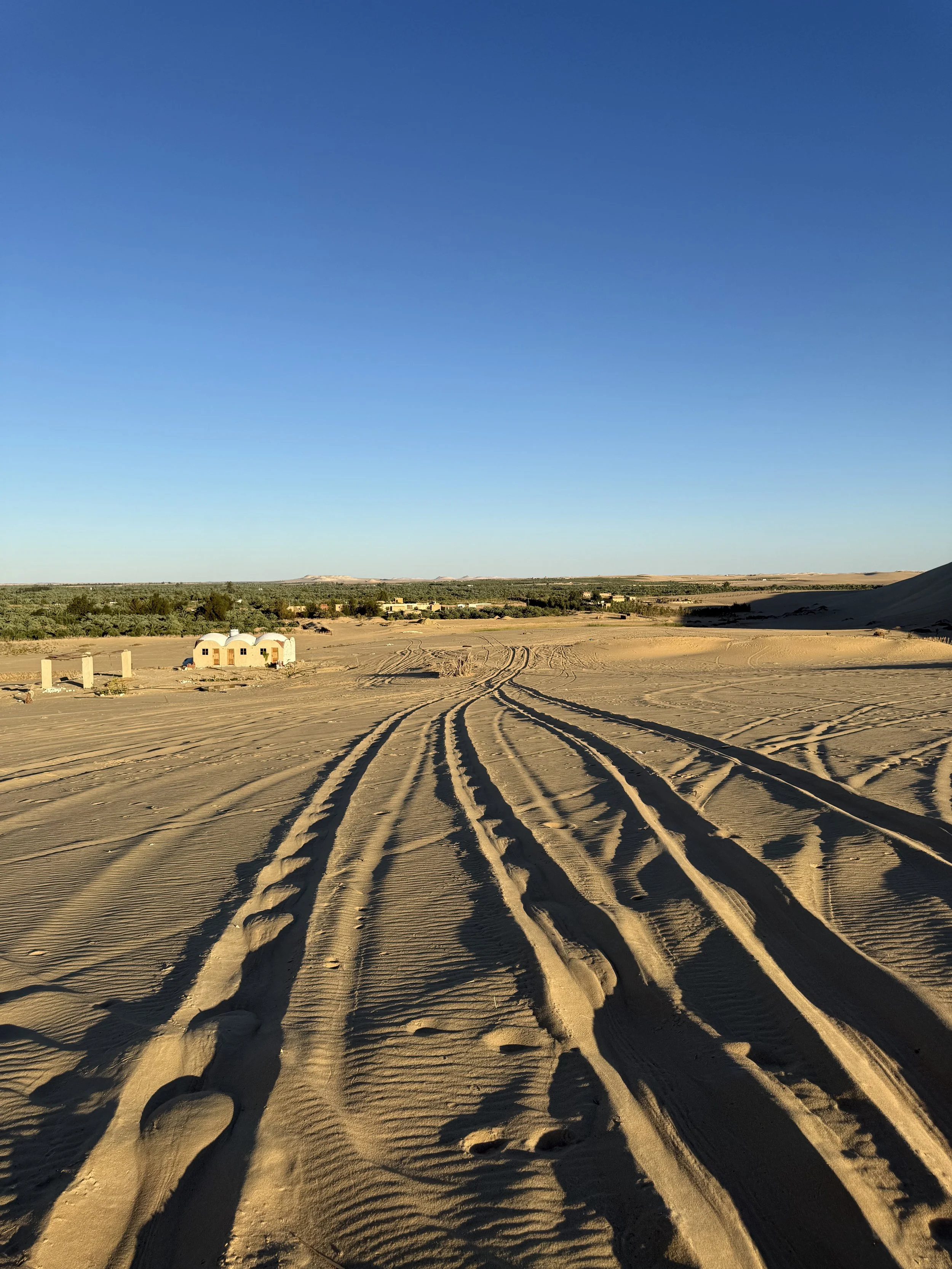
For now, I’m in Siwa. I’m teaching yoga, reconnecting with friends, and surrounded by palm trees, desert, hot springs, and some of the most extraordinary night skies I’ve ever seen.
I have work to do, things to write, people to meet, and plenty more mistakes to make.
Hopefully some hilarious ones.
My life may not look simple from the outside, but I’m beginning to think simplicity has very little to do with how much we own, how educated we are, or how complicated our schedules have become.
Perhaps it has more to do with knowing what actually matters.
I still have my body.
I still have my mind.
I still have my feet.
And I still have the freedom to walk.
For now, that is enough.
The road keeps appearing.
